




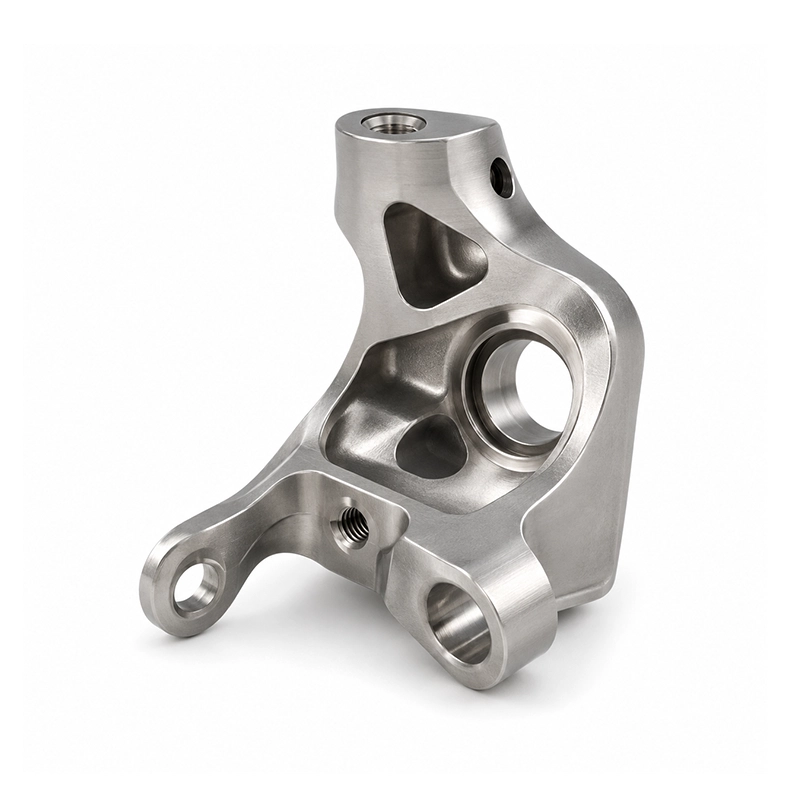

5-Axis CNC Medical Device Components
Five-axis CNC machining enables the production of contoured surfaces, mounting interfaces, and features approached from different directions without simplifying the intended geometry. These medical CNC machined parts are applicable to surgical instruments, diagnostic equipment, and other medical device assemblies.
Quick Info:
- Material: Stainless Steel 316L / Titanium / Aluminum / PEEK
- Machining Type: 5-Axis CNC Machining
- Tolerance: ±0.01–0.03 mm
- Surface Finish: Ra 0.4–1.6 μm
- Production Volume: Prototype / Low Volume / Batch Production
- Lead Time: 7–15 Working Days

Get Free Quote


Detailed Description
An imaging-system support may require a flat mounting seat on one face and an angled instrument interface on another. medical CNC machined parts can combine such features with curved outer contours, pockets and controlled locating surfaces in a single machined body. The relative position of the interfaces governs fit inside a compact medical equipment assembly.
Five-axis tool movement gives access to bores and faces distributed around the component. Fewer workholding changes can help control the positional relationship between critical features, although cutting strategy and verification still depend on the specific drawing.
Available Surface Finishes
- As-Machined: Suitable for prototype and internal equipment components.
- Fine Machining: Provides improved surface quality on functional interfaces.
- Passivation: Common for stainless steel components requiring improved corrosion resistance.
- Electropolishing: Available for selected stainless steel components requiring smoother surfaces.
- Anodizing: Provides additional surface protection for aluminum components.
- Polishing: Available for selected functional and appearance surfaces.
Stainless steel 316L, titanium, aluminum and PEEK offer different options for mass, corrosion behavior and mechanical needs. Passivation, electropolishing, anodizing or selected polishing may apply depending on the chosen material and specified surface function.
Structural & Functional Breakdown
- Complex Contoured Surfaces: Support ergonomic or compact medical equipment designs.
- Precision Mounting Interfaces: Provide reliable references for instrument and equipment assembly.
- Angled Bores: Allow fasteners, shafts and functional elements to be positioned at non-orthogonal angles.
- Deep Pockets: Create lightweight structures and clearance for adjacent components.
- Multi-Surface Features: Combine several mechanical functions within a single precision-machined component.
A deep pocket can make room for a fastener head or neighboring module without changing the outside envelope. Angled bores establish alternate assembly directions, while a stable reference face helps locate the part during installation and inspection.
Key Features
- Complex Medical Geometry: 5-axis machining supports curved surfaces, angled holes and compact multi-plane designs.
- Precision Interface Control: Mounting surfaces and locating features can maintain accurate relationships across the component.
- Medical-Grade Material Options: Stainless steel 316L, titanium, aluminum and PEEK support different equipment requirements.
- Reduced Repositioning: Fewer machining setups help maintain consistency between critical functional features.
- Fine Surface Capability: Functional areas can be machined or secondarily finished to meet surface requirements.
- Prototype & Low-Volume Production: Suitable for medical equipment development, validation builds and specialized production.
In a diagnostic instrument mount, medical CNC machined parts can position an angled connector interface beside a flat equipment datum and a curved clearance surface. Prototype fitting then checks nearby components, tool access and the actual connection arrangement.
Applications
- Surgical Instruments
- Diagnostic Equipment
- Medical Imaging Systems
- Medical Robotics
- Laboratory Equipment
- Positioning Systems
- Rehabilitation Equipment
- Medical Device Prototypes
This machining scope addresses component geometry, not medical-device approval. Any requirement for biocompatibility, sterility, traceability or regulated use must be defined and verified separately for the finished product.

Frequently Asked Questions
-
When is five-axis machining useful for a medical component?

-
It helps access geometry spread across several orientations, such as angled bores, curved surfaces and multiple equipment interfaces.
-
Can angled holes and flat datums be machined together?
-
They can be planned in fewer setups, depending on workholding and tool reach. Critical feature relationships still need inspection.
-
Which materials appear in the available options?
-
The supplied range includes stainless steel 316L, titanium, aluminum and PEEK, with selection based on the functional requirements.
-
Does 316L automatically make a component suitable for implantation?
-
No. Material selection alone does not establish clinical suitability, regulatory compliance, biocompatibility or sterilization compatibility.
-
What is the purpose of a machined clearance pocket?
-
It creates room for adjacent parts, hardware or tool access within a limited equipment envelope.
-
How should multiple mounting interfaces be dimensioned?
-
Provide datums and geometric controls that express how the interfaces must relate in the assembled device.
-
Can polishing or electropolishing be specified?
-
Selected compatible metal surfaces may receive these treatments. Final options depend on geometry, finish target and material.
-
What should accompany the CAD drawing?
-
Include material, critical interface dimensions, surface requirements, assembly context and any quality or regulatory specifications relevant to the final use.


