




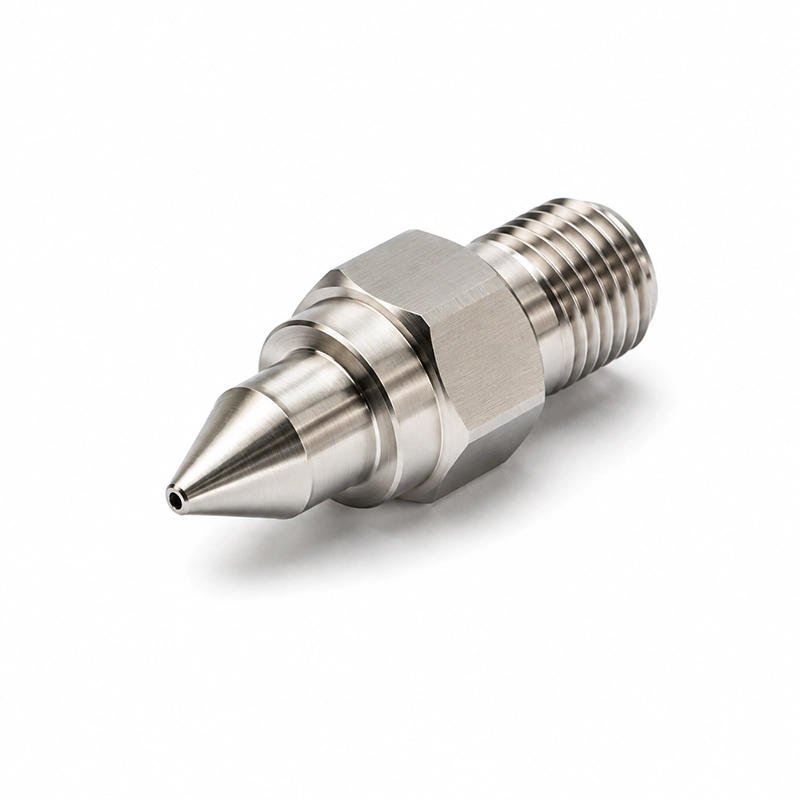

Swiss Machined Miniature Nozzles
Precision Swiss machined nozzles can incorporate fine bores, tapered outlets, threaded ends, and compact connection details in one turned component. These features define the geometry through which fluid or gas passes and how the nozzle attaches to the surrounding equipment. The combination of small diameters and detailed internal machining makes this approach suitable for dispensing, fluid handling, and other systems with closely spaced mechanical features.
Quick Info:
- Material: Stainless Steel / Brass
- Machining Type: Swiss Turning / Turn-Mill Machining
- Diameter Range: 1–20 mm
- Dimensional Tolerance: ±0.005–0.02 mm
- Surface Finish: Ra 0.2–1.6 μm
- Lead Time: 5–12 Working Days

Get Free Quote


Detailed Description
The small exit opening of a dispensing tip connects the internal passage to the surrounding process. precision machined nozzles can combine a stepped axial bore with a taper at the discharge end and a threaded mounting section at the opposite side. Such geometry appears in lubrication points, cooling jets, gas outlets and compact fluid-delivery fixtures.
Swiss-type machining supports slender bar stock near the cut, allowing external steps and threads to be produced alongside small axial features. Live tooling can add flats or secondary holes where the mounting or flow configuration calls for them.
Available Surface Finishes
- As-Machined: Standard finish for general fluid-control applications.
- Fine Turning: Provides improved surface quality on precision external and internal features.
- Polishing: Available for applications requiring smoother flow-contact surfaces.
- Passivation: Improves corrosion resistance for stainless steel components.
- Nickel Plating: Available for brass parts requiring additional surface protection.
Fine turning and selected polishing can address areas exposed to the flowing medium. Passivation for compatible stainless steel or plating for certain brass components may be considered after checking media and finish requirements.
Structural & Functional Breakdown
- Micro Flow Bores: Small internal passages control fluid or gas delivery.
- Tapered Outlet Profiles: Guide flow toward a controlled discharge point.
- Threaded Interfaces: Allow direct connection to fittings or equipment.
- Stepped Internal Geometry: Supports different flow sections within one miniature component.
- Cross-Hole Features: Provide secondary fluid routes or distribution paths.
A tapered tip influences the location of the discharge edge, while the bore and intersecting passage form the internal path. Burrs or unintended restrictions at these junctions need attention during part inspection and any specified cleaning work.
Key Features
- Small-Diameter Machining: Swiss machining supports miniature nozzle bodies and fine internal features.
- Controlled Flow Geometry: Precision bores and tapered sections can be produced according to application requirements.
- High Concentricity: Internal passages and external diameters can maintain accurate alignment.
- Integrated Secondary Features: Cross holes, flats and threads can be produced through turn-mill operations.
- Multiple Material Options: Stainless steel and brass support different fluid and operating environments.
- Prototype & Batch Production: Suitable for development samples and repeat precision manufacturing.
In a small lubricant applicator, precision machined nozzles can use an external thread to secure the body and a fine internal bore to lead fluid toward the outlet. Physical checks can examine the connection, outlet condition and overall assembly before operating performance is validated.
Applications
- Fluid Dispensing Systems
- Medical Equipment
- Pneumatic Systems
- Cooling Systems
- Lubrication Equipment
- Laboratory Instruments
- Automation Equipment
- Precision Spray Systems
A nozzle drawing should identify bore size, outlet geometry, material, thread, edge treatment and required inspection details. Flow rate or spray behavior cannot be inferred from the shape alone without the fluid properties and operating conditions.

Frequently Asked Questions
-
How does a tapered outlet affect a nozzle design?

-
It sets the geometry near the discharge opening. Actual flow and spray behavior also depend on the medium, pressure and complete flow path.
-
Can tiny axial holes be included in a Swiss-turned part?
-
Small passages are possible within limits set by tool access, depth, material and the specified bore dimension.
-
What needs attention where two passages intersect?
-
The junction may require checks for burrs, unintended restrictions and the correct location of each opening.
-
Which materials are commonly considered?
-
Stainless steel and brass provide different corrosion and machinability characteristics. Media compatibility should guide selection.
-
Can the outlet be polished?
-
Selected flow-contact surfaces may receive polishing or fine finishing where geometry allows. The treatment must not alter a critical outlet size.
-
Are machined nozzles limited to liquid dispensing?
-
No. The source applications also include gas outlets, cooling jets, lubrication and pneumatic systems.
-
Can cross holes or wrench flats be added?
-
Live tooling may add side openings or flats when the body dimensions and tool access permit.
-
What data are needed to review a nozzle?
-
Include the bore and tip drawing, operating medium, connection details, material, quantity and any required flow or cleanliness testing.


