




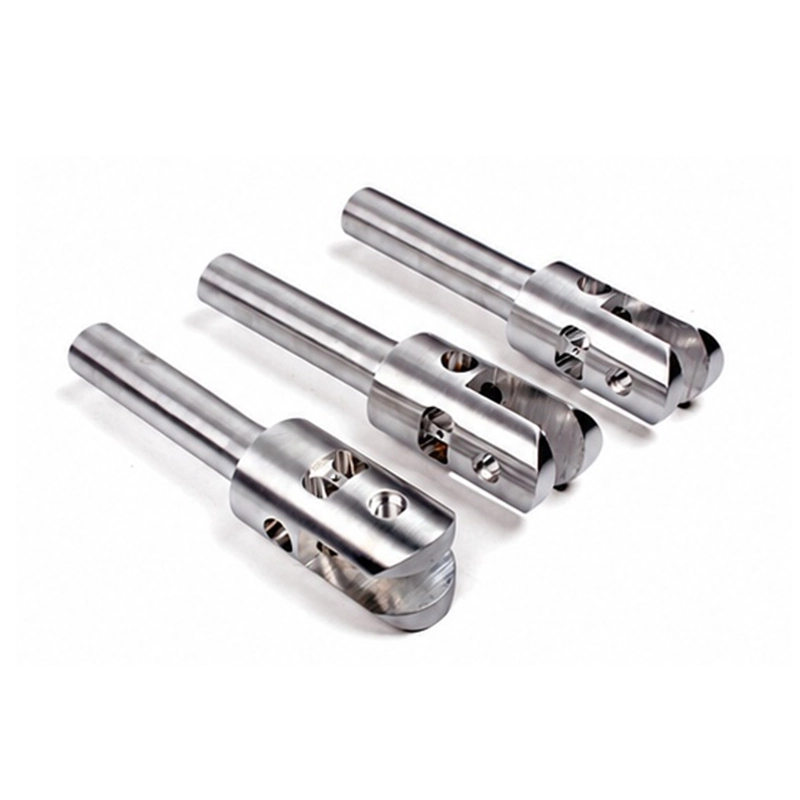

Precision CNC Machined Stainless Steel Shafts
Custom CNC machined stainless steel shafts may include bearing seats, grooves, threads, and stepped diameters along a common axis. These details define the location of supported and attached parts in transmission or automation assemblies.
Quick Info:
- Material: Stainless Steel 304 / 316 / 17-4PH
- Process: CNC Milling
- Tolerance: ±0.01–0.03 mm
- Surface Finish: Passivation / Polishing / Grinding
- MOQ: 1 Piece
- Lead Time: 5–12 Working Days

Get Free Quote


Detailed Description
Bearing seats and stepped shoulders organize rotating hardware along the length of a shaft. Machined stainless steel shafts carry those interfaces in corrosion-resistant material, serving pumps, gearbox assemblies and automated motion equipment. Single components can position a bearing, retain a spacer and connect to a drive element at different axial locations.
Turning establishes the main diameters and the transitions between them. Narrow retaining-ring grooves provide axial stops; threaded ends carry fasteners or adjustment hardware. Keyways and flats introduce positive connections where adjoining gears or couplings transmit torque.
Bearing Fits And Corrosion-Resistant Shaft Surfaces
Machined stainless steel shafts use grades 304, 316 and 17-4PH across different mechanical applications. Fine turning forms the primary geometry, while grinding or polishing can create smoother bearing and sliding regions. Passivation and electropolishing are available for selected exposed surfaces.
Available Surface Finishes
- Fine Turned Finish: Standard precision-machined shaft surface.
- Centerless Grinding: Available for controlled diameter and surface quality.
- Polishing: Produces smoother surfaces for visible or low-friction applications.
- Passivation: Improves corrosion resistance of stainless steel.
- Electropolishing: Available for selected clean or corrosion-sensitive applications.
- Black Oxide: Available for suitable steel shaft materials when specified.
Working faces may retain a finely turned texture or receive a smoother finish. Metal surfaces follow the shaft through bearing seats, seal contact regions and exposed sections.
Structural & Functional Breakdown
- Bearing Seats: Precision diameters support bearings and rotating assemblies.
- Stepped Diameters: Allow multiple components to be positioned on one shaft.
- Threaded Ends: Support nuts, fasteners and assembled components.
- Keyways & Flats: Transfer torque or prevent component rotation.
- Retaining Grooves: Accommodate circlips and axial positioning elements.
Shoulders locate adjacent parts without loose spacers everywhere along the axis. Retaining grooves and keyways support distinct axial and rotational connections.
Key Features
- Precision turning for concentric shaft geometry
- Multiple stainless steel grades available
- Custom threads, grooves, flats and keyways
- Tight control of bearing and mating diameters
- Grinding and polishing options available
- Suitable for prototypes and repeat production
Shaft profiles remain distinct from end to end: one diameter locates a bearing, another carries a driven element, and the tip provides fastening.
Applications
- Motors & Gearboxes
- Automation Equipment
- Pumps
- Conveyor Systems
- Robotics
- Linear Motion Equipment
- Industrial Machinery
- Transmission Assemblies
Pump shafts position bearings and seals along the same rotating centerline while extending into the driven mechanism. Stainless surfaces remain useful where the assembly encounters moisture or cleaning contact.
Conveyor drives and linear-motion equipment apply the turned profile differently. Stepped areas support couplings, moving guides and retention hardware, keeping multiple functions on one continuous metal member.

Frequently Asked Questions
-
Which stainless steel grades are used for machined shafts?

-
Reference includes 304, 316 and 17-4PH stainless steel among the shaft material options.
-
How are bearing seats formed?
-
Precision turning establishes stepped cylindrical regions, with grinding also available for selected contact surfaces.
-
Can a shaft include grooves and threaded ends?
-
Machining can produce retaining-ring grooves, shoulders and internal or external threaded connections on the same shaft.
-
What is the purpose of a keyway?
-
Keyways connect the shaft to a mating drive component through a mechanical key, reducing relative rotation at the joint.
-
What finishes are available for stainless shaft surfaces?
-
Fine turning, grinding, polishing, passivation and electropolishing are included among the finishing choices.
-
How do shoulders position mechanical parts?
-
Turned diameter changes create axial stops for bearings, spacers, couplings and other mounted hardware.
-
Can stainless shafts be used in pumps?
-
Pump systems use turned shaft interfaces for bearings, seals and driving connections, including assemblies that encounter moisture.
-
Where are these shafts commonly installed?
-
Gearboxes, robotics, conveyor systems, linear-motion equipment and industrial machinery use stepped stainless shaft forms.


