




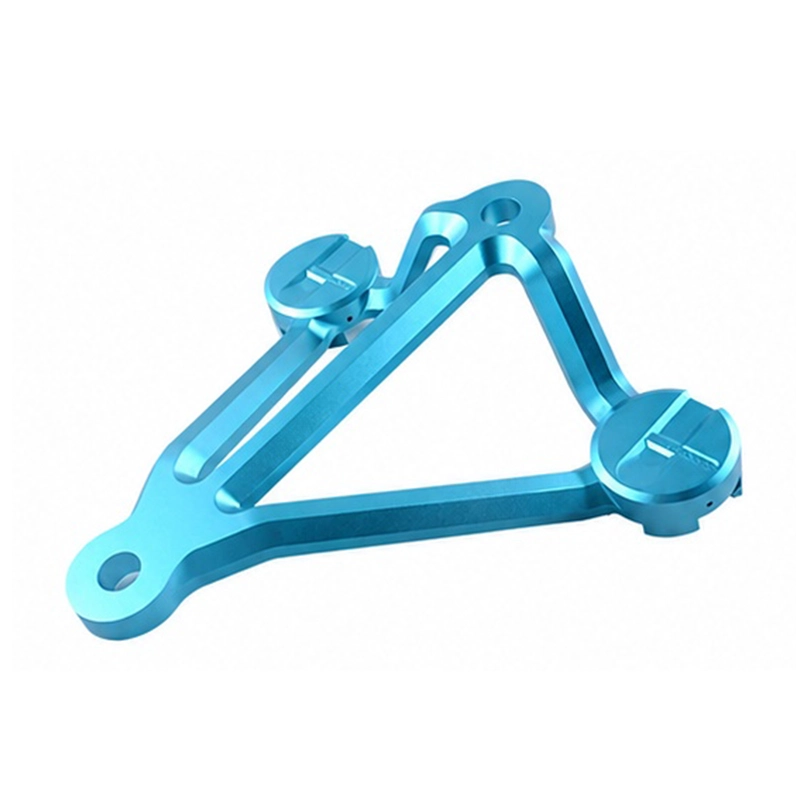

Custom CNC Machined Aluminum Structural Brackets
Custom CNC machined aluminum brackets can include mounting holes, pockets, and reinforced profiles without the weight of a solid rectangular block. The aluminum construction is useful where component mass and accessible mounting space are design considerations. These brackets are used in machinery, automation systems, and industrial equipment.
Quick Info:
- Material: Aluminum 6061 / 6082 / 7075
- Process: CNC Milling
- Tolerance: ±0.03–0.05 mm
- Surface Finish: Anodizing / Bead Blasting / Powder Coating
- Machining Type: 3-Axis / 4-Axis / 5-Axis
- MOQ: 1 Piece
- Lead Time: 5–12 Working Days

Get Free Quote


Detailed Description
Motor supports and sensor arms often connect surfaces at different heights or angles. CNC machined aluminum brackets join those positions through one solid machined form, with reinforced ears around the fasteners and pockets through open sections. Angled mounting faces help the attached equipment meet a surrounding frame without separate joining plates.
Aluminum 6061-T6, 6082 and 7075 support machined ribs, bosses and threaded locations. Pocket milling opens the body between connection regions, while solid material remains around bolt holes and bearing faces. Small locating bores can share a face with the threaded hardware.
Lightweight Arms Between Offset Mounting Planes
An actuator bracket may place a narrow arm between a base plate and a raised fastener group. Internal pockets reveal the supporting rib network, while the outer faces remain accessible for installation tools. Its form stays compact even when the mounting planes point in different directions.
Available Surface Finishes
- As-Machined: Standard machining finish for internal structural components.
- Bead Blasting: Creates a uniform matte technical appearance.
- Clear Anodizing: Improves corrosion resistance while retaining the aluminum appearance.
- Black Anodizing: Common for industrial machinery and automation equipment.
- Hard Anodizing: Improves wear resistance on frequently assembled surfaces.
- Powder Coating: Available for larger brackets requiring additional surface protection.
Anodized finishes give exposed aluminum a consistent surface around complex arms and pockets. Machined contact faces retain their role as reference points for attached equipment.
Structural & Functional Breakdown
- Reinforced Mounting Areas: Additional material around high-load holes improves strength.
- Precision Mounting Faces: Machined surfaces provide accurate assembly references.
- Weight-Reduction Pockets: Reduce component mass while maintaining structural rigidity.
- Threaded Interfaces: Integrated threads simplify downstream assembly.
- Multi-Plane Geometry: Supports components mounted at different angles and positions.
Reinforced bolt regions and relieved interior sections complement each other without turning the bracket into a flat plate. Local material remains visible along the load path.
Key Features
- Lightweight, high-strength aluminum construction
- Custom 2D and 3D bracket geometries
- Precision hole and mounting-face machining
- Integrated ribs, pockets and threaded features
- Prototype and batch production available
- Manufactured directly from customer CAD drawings
Single-piece machining brings several mounting directions into a readable structural form, useful when a frame lacks a simple perpendicular connection.
Applications
- Industrial Machinery
- Automation Equipment
- Robotics
- Motor Mounting Systems
- Sensor Supports
- Actuator Brackets
- Machine Frames
- Production Equipment
In robotic subassemblies, CNC machined aluminum brackets raise a sensor or motor away from a frame through stiff supporting arms. Recessed regions provide clearance for adjacent moving hardware.
Machine-frame connections employ similar shapes for a different purpose: offset faces bridge two installation planes, and integrated threads allow equipment to attach directly to the machined support.

Frequently Asked Questions
-
Can mounting faces sit on different planes?

-
CNC machining can produce offset or angled faces, holes and bosses in one aluminum structural bracket.
-
What functions do reinforcement ribs serve?
-
Ribs add local support between loaded connection areas while leaving surrounding regions available for lightening pockets.
-
Which aluminum grades appear for structural brackets?
-
6061-T6, 6082 and 7075
-
Can threaded attachment points be integral?
-
Tapped holes and machined bosses can form part of the bracket without separate threaded plates.
-
Why use pockets in a solid aluminum bracket?
-
Milled pockets remove material outside prominent mounting regions and create room around nearby equipment.
-
Are black anodized brackets available?
-
Black anodizing appears alongside clear and hard anodizing, bead blasting, as-machined finishes and powder coating.
-
Can sensor supports and actuator brackets share this construction?
-
Both can use reinforced mounting ears, angled arms and machined locating faces to connect equipment to frames.
-
Where do these brackets appear in machinery?
-
Robotics, automation equipment, motors, actuators and production machine frames use these support geometries.


