




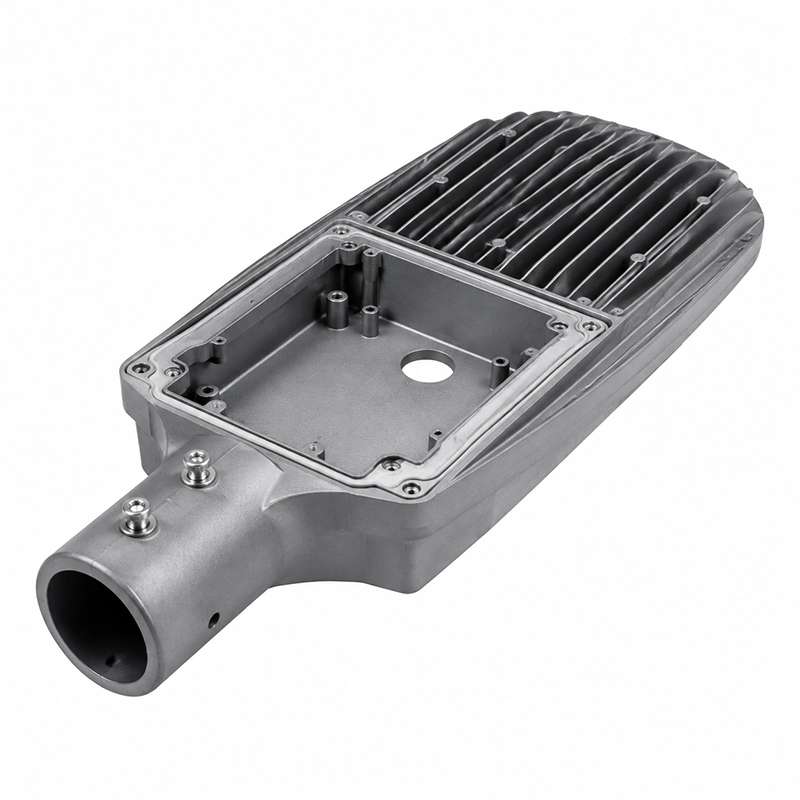

Die Cast Lighting Housings
These die cast lighting housings bring heat-dissipating structures, fastening features, and protective metal walls into a single shaped component. The casting process can form ribs, recesses, and external profiles suited to different fixture layouts. For lighting equipment manufacturers, the resulting housing provides a defined mechanical platform for placing light sources, securing related parts, and managing the enclosure geometry within the overall product design.
Quick Info:
- Material: Aluminum Alloy
- Process: High Pressure Die Casting
- Wall Thickness: 1.5–5.0 mm
- Dimensional Tolerance: ±0.10–0.30 mm
- Surface Finish: Powder Coating / Anodizing
- Lead Time: 15–30 Working Days

Get Free Quote


Detailed Description
Die cast lighting housings bring the protective shell and the heat-dissipation structure of an LED fixture into one metal component. Typical forms include road-light heads, industrial lamp bodies and floodlight enclosures. External ribs enlarge the available surface area, while internal mounting pads provide contact points for a light engine or associated hardware.
Aluminum alloys suit this construction because they conduct heat and can form detailed cast features. Thermal behavior also depends on the LED power, contact surfaces, airflow, coating and fin spacing. The casting itself does not establish a fixture temperature rating without tests of the assembled lamp.
Available Surface Finishes
- Powder Coating: Provides weather resistance and customized appearance.
- Anodizing: Improves aluminum corrosion resistance.
- Shot Blasting: Creates a uniform matte finish.
- Machining: Adds mounting holes and precision interfaces.
- Painting: Supports customized colors.
Cable openings, threaded attachment positions and rib geometry can be incorporated into the tool design. Secondary machining can refine the surfaces where a heat-transfer plate, bracket or sealing component needs a controlled fit.
Structural & Functional Breakdown
- Integrated Cooling Ribs: Improve heat dissipation performance.
- Mounting Bosses: Provide secure installation points.
- Protective Housing Structure: Shields internal LED components.
- Cable Entry Features: Supports wiring installation.
- Thin Wall Construction: Balances weight and structural strength.
For exposed installations, finish selection should account for corrosion conditions and heat flow. Powder coating, painting and selected metal treatments require review for the chosen alloy and operating environment.
Key Features
- Thermal Management Design: Aluminum die casting supports efficient LED heat dissipation.
- Complex Housing Geometry: Cooling fins, ribs and mounting structures can be integrated.
- Durable Outdoor Construction: Suitable for demanding lighting environments.
- Lightweight Aluminum Structure: Reduces fixture weight while maintaining strength.
- Custom Surface Finishes: Supports both functional and decorative requirements.
- Mass Production Capability: Suitable for commercial lighting projects.
A floodlight housing may place dense cooling fins behind the LED board while keeping mounting lugs at the sides. Die cast lighting housings allow these zones to share the same casting and reduce the number of separate structural pieces.
Applications
- LED Street Lights
- Industrial Lighting
- Outdoor Lighting Fixtures
- Commercial Lighting
- Flood Lights
- Architectural Lighting
- Smart Lighting Systems
Water resistance depends on the complete fixture, including gasket grooves, cover joints, cable glands and fasteners. The enclosure design should reserve suitable sealing geometry before any ingress-protection claim is considered.

Frequently Asked Questions
-
How do cast fins support an LED lighting assembly?

-
External fins increase exposed metal surface area. Actual heat transfer depends on fin geometry, airflow, alloy, power input and the thermal contact to the LED module.
-
Can cable entries be included in the housing?
-
Yes. Openings and mounting regions can be incorporated into casting geometry, with machining where tighter interfaces are needed.
-
Are threaded holes cast or machined?
-
Some hole forms may be cast as pilots; critical threads commonly call for secondary machining based on the drawing.
-
Does a die cast housing provide an IP rating by itself?
-
No. Ingress protection applies to the tested complete assembly, including covers, gaskets, cable entries and fastening details.
-
What finishes can be considered for exterior fixtures?
-
Powder coating, paint, blasting and selected alloy-compatible metal treatments may be reviewed against appearance and environment requirements.
-
Can mounting brackets be included in the casting?
-
Mounting bosses or lugs can be part of the tool geometry if their wall sections and loads fit the casting design.
-
What information supports thermal design review?
-
LED power, board size, target temperatures, mounting orientation, airflow assumptions and contact details help establish the housing geometry.
-
Can the enclosure be machined after die casting?
-
Yes. Machining can produce more controlled contact faces, mounting holes and threaded features after casting.
-
What affects visible surface quality?
-
Alloy selection, tool condition, casting geometry and finishing method influence the final exposed surfaces.


