




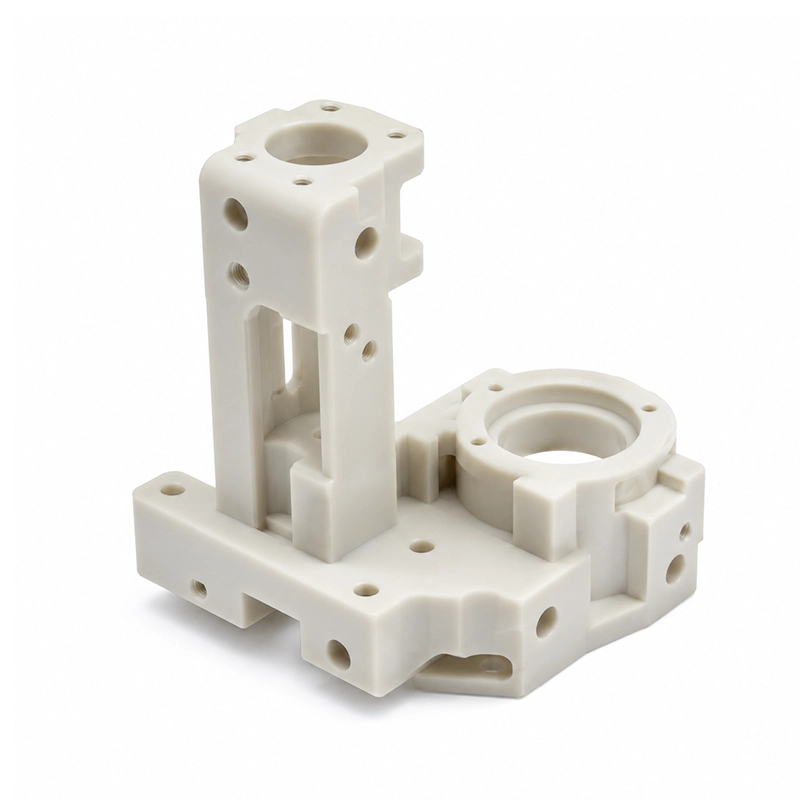

Precision CNC Milled Engineering Plastic Components
CNC machined plastic parts can be produced from materials such as POM, PEEK, and nylon with milled pockets, bores, slots, and locating surfaces. Material selection may be driven by weight, insulation, wear behavior, or the operating environment. Machining from plastic stock is suitable for parts whose shape and connection details need to match a specific mechanical assembly without dedicated molding tools.
Quick Info:
- Material: POM / PEEK / Nylon / PC
- Machining Type: 3-Axis / 4-Axis CNC Milling
- Tolerance: ±0.03–0.10 mm
- Surface Finish: As-Machined / Deburring / Polishing
- Production Volume: Prototype / Low Volume / Batch Production
- Lead Time: 5–12 Working Days

Get Free Quote


Detailed Description
A machine guide or insulating spacer needs geometry suited to its mating parts, not just a material swap from metal. CNC machined plastic parts can include recessed pockets, locating bores and sliding faces in one milled component. POM, PEEK, nylon and polycarbonate offer different friction, temperature and moisture responses.
Deburring and Edge Quality on Engineering Plastics
- As-Machined: Standard finish for functional engineering plastic components.
- Deburring: Removes machining burrs from holes, edges and milled features.
- Mechanical Polishing: Available for selected plastics requiring improved surface appearance.
- Edge Finishing: Produces cleaner edges for handling and assembly.
- Custom Surface Treatment: Available depending on the selected plastic material.
Deburring and edge finishing help prevent raised material from interfering with assembly. Cosmetic polishing depends on the polymer and may be inappropriate for a working wear face.
Pockets, Wear Faces and Precision Bores
- Precision Bores: Support shafts, pins and locating components.
- Machined Pockets: Reduce weight or provide clearance for adjacent components.
- Insulating Features: Engineering plastics can electrically isolate components within assemblies.
- Wear Surfaces: Low-friction materials can be used for guides and sliding interfaces.
- Custom Mounting Geometry: Holes, slots and locating features can be machined directly from CAD data.
Thin webs and unsupported walls can deflect under cutting forces or clamping pressure. Workholding can support the part near precision pockets and bore locations. Material grade, stock condition and inspection temperature also matter when dimensional stability is important.
Material Selection and Dimensional Control
- Broad Material Selection: POM, PEEK, Nylon, PC and other engineering plastics can be selected for different operating requirements.
- Lightweight Construction: Plastic components reduce assembly weight compared with equivalent metal parts.
- Electrical Insulation: Suitable materials can isolate electrical and electronic components.
- Low-Friction Performance: POM, Nylon and similar plastics can support sliding and wear applications.
- Complex Machined Geometry: Pockets, bores, slots, threads and three-dimensional profiles can be produced without molding tooling.
- Low-Volume Production: Suitable for prototypes and functional production parts without injection mold investment.
For CNC machined plastic parts, drawings can distinguish locating faces from noncritical outer contours. A sliding guide may require clearance and wear evaluation, while an electrical support may need attention to dielectric behavior and operating temperature.
Functional Uses in Mechanical Equipment
- Industrial Automation
- Electrical Equipment
- Medical Equipment
- Semiconductor Equipment
- Robotics
- Precision Instruments
- Food Processing Equipment
- Mechanical Assemblies
Low-volume equipment assemblies often need several versions of a bracket, spacer or guide. Milling from stock allows the hole pattern or pocket position to change between trials without committing to a mold.

Frequently Asked Questions
-
What plastics can be CNC milled?

-
POM, PEEK, nylon and polycarbonate are among the engineering plastics considered, depending on the required properties.
-
Why can plastic move during machining?
-
Some polymers respond to clamping pressure and cutting heat.
-
Can plastic guide surfaces replace a metal contact part?
-
Some polymers suit sliding applications, but operating load, wear rate and temperature need evaluation.
-
Are threaded holes practical in plastic?
-
Threads can be machined when geometry permits. Fastener load and repeated assembly may call for inserts or revised fastening details.
-
Is nylon dimensionally stable in humid environments?
-
Nylon may absorb moisture and change dimension. Grade selection and environmental requirements should be considered.
-
How are burrs removed from plastic edges?
-
Deburring and edge finishing can remove raised material while protecting critical locating surfaces.
-
Can a single prototype be milled without a mold?
-
Yes. Machining from stock is suitable for prototypes and small quantities where tooling investment is not warranted.
-
What drawing details matter most?
-
Specify material grade, mating dimensions, hole locations, allowable fit and any critical wear or insulating surfaces.
-
Can a plastic part include deep pockets?
-
Many pockets are machinable, but tool reach, wall thickness and material deflection need a geometry review.


