




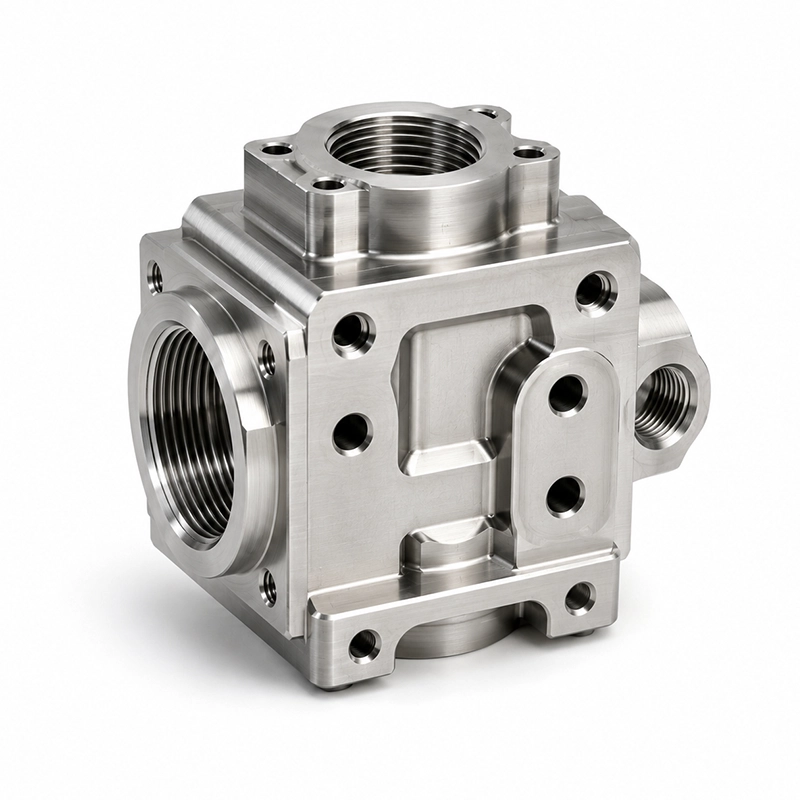

CNC Milled Stainless Steel Valve Bodies
CNC milled stainless steel valve bodies can incorporate intersecting channels, threaded connections, mounting interfaces, and finished contact faces. The material provides a metal construction suited to applications where corrosion behavior and mechanical requirements influence material selection. These parts are intended for industrial fluid and pressure-control assemblies, with internal geometry developed around the mating valve components and the specified flow path.
Quick Info:
- Material: Stainless Steel 304 / 316
- Machining Type: CNC Milling / Multi-Axis Milling
- Tolerance: ±0.02–0.05 mm
- Surface Finish: As-Machined / Passivation / Polishing
- Production Volume: Prototype / Low Volume / Batch Production
- Lead Time: 7–15 Working Days

Get Free Quote


Detailed Description
A fluid-routing valve body must connect its internal passages with the correct exterior ports and sealing seats. Stainless steel valve bodies can combine threaded inlets, machined cavities and valve-contact surfaces within a compact block. Stainless grades 304 and 316 offer different corrosion-resistance characteristics for process and equipment conditions.
Corrosion-Related Finishing Choices
- As-Machined: Standard finish for functional internal valve components.
- Passivation: Improves corrosion resistance of stainless steel surfaces.
- Mechanical Polishing: Improves surface appearance and removes machining marks where required.
- Electropolishing: Available for applications requiring smoother and cleaner stainless steel surfaces.
- Bead Blasting: Creates a uniform industrial matte appearance.
Passivation supports the corrosion behavior of compatible stainless steel surfaces. Polishing or electropolishing may suit selected requirements, but finish selection should avoid disturbing precision valve seats, threads or gasket contact areas.
Internal Channels, Seats and Threaded Ports
- Precision Flow Passages: Guide liquids or gases through controlled internal routes.
- Valve Seat Interfaces: Accurately machined surfaces support sealing and flow-control components.
- Threaded Connections: Allow direct installation of fittings and external components.
- Sealing Grooves: Support O-rings and gasket systems.
- Multi-Plane Features: Ports and mounting structures can be machined across several component faces.
Machining direction matters where an internal passage intersects another bore. Tool access, wall thickness and datum control influence whether ports and mounting faces can remain in the intended relationship. Multi-axis setups can reach several sides while limiting transfers between fixtures.
Machining Considerations for Multi-Side Valve Blocks
- Corrosion-Resistant Construction: Stainless steel supports demanding industrial and fluid environments.
- Complex Internal Geometry: CNC milling creates interconnected cavities, ports and functional pockets.
- Precision Sealing Interfaces: Valve seats, gasket faces and O-ring grooves can be accurately machined.
- Multi-Surface Machining: Features on several orientations can be completed using multi-axis setups.
- Integrated Functional Features: Threads, mounting holes and fluid connections can be combined in one component.
- Flexible Production Volumes: Suitable for prototypes, replacement components and low-volume manufacturing.
Fluid-Control Systems and Industrial Valve Uses
- Industrial Valves
- Hydraulic Systems
- Pneumatic Equipment
- Process Equipment
- Chemical Equipment
- Fluid Control Systems
- Pressure Control Equipment
- Automation Systems
Pneumatic, hydraulic and process-control bodies may share a block-like appearance but require different internal routes. The channel arrangement, seal type and fitting orientation establish the necessary machining sequence.

Frequently Asked Questions
-
Can fluid ports enter from different faces?

-
Yes. Multi-axis milling can machine ports and interfaces on several sides of the body when the geometry allows access.
-
Which stainless steel grades are considered?
-
304 and 316 are common options.
-
Are O-ring grooves and valve seats machinable?
-
Yes. Sealing grooves and seat interfaces can be machined with inspection requirements defined on the drawing.
-
Can threaded connections follow a specified standard?
-
Threads can follow designated standards within available material and wall geometry.
-
Does machining establish a pressure rating?
-
No. Pressure capability follows the complete material, geometry, seal and testing specification.
-
What should inspection cover?
-
Port position, interface geometry, sealing faces, thread details and critical wall dimensions are common checkpoints.


