




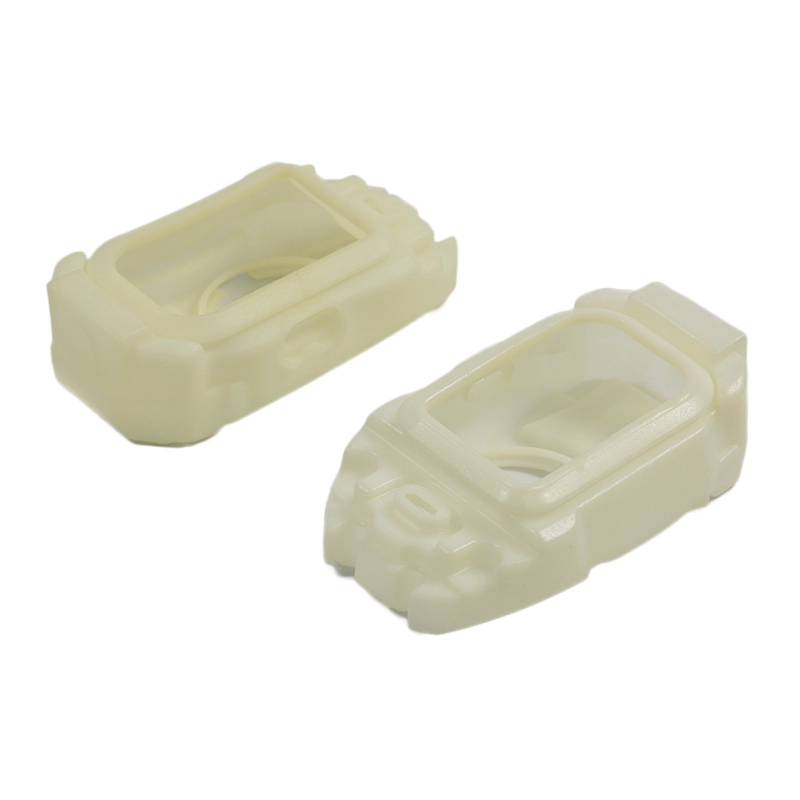

Precision Plastic Injection Molding Parts
Precision injection molded parts can incorporate ribs, clips, bosses, slots, and other details that locate or retain neighboring components. These shapes are relevant to electronic assemblies, automotive hardware, and industrial equipment, where several functions may be contained in one plastic part. Mold construction and the selected material both influence how narrow or detailed areas are reproduced. The overall geometry is developed around the required assembly rather than around decorative appearance alone.
Quick Info:
- Process: Precision Injection Molding
- Wall Thickness: 0.8–3.0 mm
- General Tolerance: ±0.05–0.15 mm
- Material: POM, PA, PC, ABS, PP, PBT
- Typical Size: 5–200 mm
- Insert Molding: Available
- Overmolding: Available

Get Free Quote


Detailed Description
Tiny ribs and clips occupy little visible space but often carry the function of a molded component. Precision injection molded parts use these details to connect compact housings, electrical interfaces and motion assemblies without spreading the design across multiple separate pieces.
Fine internal grooves guide cables and moving elements, while small bosses support screws or metal inserts. Molded openings, rib junctions and snap arms form a tightly arranged interior that still leaves defined access to the connecting surfaces.
Dense Feature Layout In Small Polymer Parts
POM, PA6, PA66, PC, ABS, PP and PBT appear in precision molding applications. Their use spans compact guides, sensor bodies and connector elements with intricate mechanical interfaces.
Available Surface Finishes
- Standard Molded Finish: Cost-effective finish for internal functional plastic components.
- Fine Matte Texture: Provides a uniform low-gloss appearance on precision parts.
- High-polish Finish: Suitable for smooth, decorative or low-friction surfaces.
- VDI Texture: Controlled mold textures can be selected according to application requirements.
- Laser Marking: Adds permanent codes, identification and functional symbols.
- Pad Printing: Suitable for compact logos and markings on small components.
Polished or fine-matte finishes distinguish contact faces from exterior surfaces. Small symbols or part codes fit beside molded attachment details.
Structural & Functional Breakdown
- Fine Rib Structure: Thin ribs increase local stiffness within limited space.
- Precision Boss Structure: Molded screw bosses support repeatable positioning and fastening.
- Snap-fit Structure: Small integrated clips enable quick mechanical assembly.
- Internal Groove Structure: Channels can guide wires, connectors or moving mechanisms.
- Insert Interface Structure: Metal pins, bushes and threaded inserts can be incorporated.
- Multi-cavity Mold Structure: Small parts can be arranged in multi-cavity tooling for improved output.
Narrow ribs and insert seats give each small part several working surfaces. Molded snap arms also allow mechanical joining without an exposed screw on every interface.
Key Features
- Precision Dimensional Control: Typical ±0.05–0.15 mm dimensional control for suitable geometries.
- Multi-cavity Tooling: Supports 1–16 or more cavities depending on part size and geometry.
- Engineering Plastic Processing: Supports wear-resistant, reinforced and dimensionally stable resins.
- Insert & Overmolding Capability: Metal inserts or secondary materials can be integrated where required.
- Complex Detail Molding: Fine ribs, slots, holes, bosses and undercuts can be incorporated into one component.
- High Repeatability: Stable tooling and process control support consistent batch production.
Compact components often carry their identification and fastening features in the same small footprint. This dense arrangement is central to miniature electronic and mechanical assemblies.
Application Fields
- Electronic Components
- Sensor Housings
- Connector Components
- Automotive Mechanisms
- Small Gear & Motion Components
- Control System Parts
- Appliance Components
- Industrial Precision Parts
Electronic connectors and sensor housings place clips, bosses and openings close together. One molded part keeps the surrounding assembly compact.
Small motion-control components use precision injection molded parts for guides, retaining details and narrow interface geometry. Their value lies in the arrangement of several small functions rather than in decorative surface treatment.

Frequently Asked Questions
-
Which small structures can precision molding reproduce?

-
Fine ribs, small bosses, snap arms, internal grooves and insert locations appear in compact molded designs.
-
Can metal inserts be included in a small molded part?
-
Selected inserts can be incorporated alongside molded fastening and locating geometry.
-
What materials are commonly used?
-
POM, PA6, PA66, PC, ABS, PP and PBT cover a range of small mechanical components.
-
What is multi-cavity tooling?
-
Several copies of a part form within a mold during one production cycle.
-
How are small molded pieces joined?
-
Snap fits, threaded insert seats and compact screw bosses provide different joining features.
-
Which finishes appear on precision molded components?
-
Standard technical surfaces, fine matte textures, polished areas and VDI textures are listed options.
-
Can the component carry identification?
-
Laser marking and pad printing place codes and symbols on suitable surfaces.
-
Where are these parts found?
-
Electronic connectors, small gears, sensor housings and control-system components use detailed molded geometry.


