




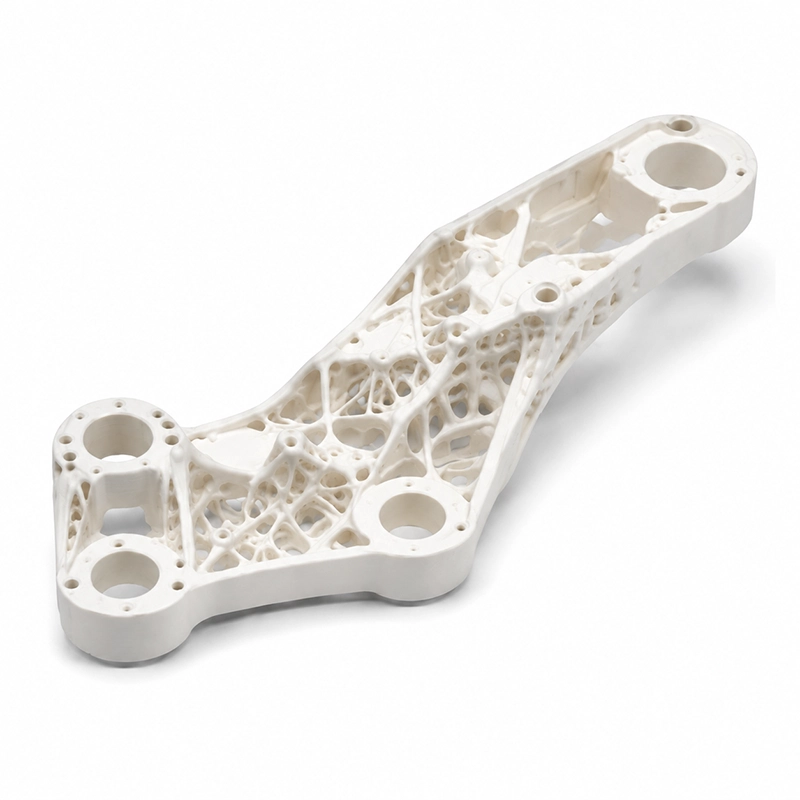

3D Printed Complex Lightweight Components
These 3D printed lightweight components incorporate lattice structures, topology-optimized forms, and complex internal features to reduce material usage and component weight. Additive manufacturing enables intricate shapes that are difficult to produce through conventional machining, offering greater design flexibility for parts with specific structural requirements. By adjusting material distribution and internal geometry, these components support weight reduction while accounting for the functional demands of different engineering applications.
Quick Info:
- Process: SLS / MJF / SLA 3D Printing
- Material: Nylon / TPU / Engineering Resin
- Tolerance: ±0.10–0.15 mm
- Structure: Lattice / Bionic / Topology Optimized
- Lead Time: 4–8 Working Days

Get Free Quote


Detailed Description
Weight-sensitive mechanical assemblies need secure fastening points without filling every gap with solid material. 3D printed lightweight components combine open lattice sections with topology-guided contours to keep material where the design needs it. Drone supports, robotic brackets, and aerospace development parts can incorporate mounting points and curved structural members in a single geometry.
Lattice openings remove material from selected regions, while thicker sections surround bolt holes, contact surfaces, and attachment points. The shape can reduce the number of separate pieces in an assembly. Mechanical behavior still depends on the loading direction, cell geometry, build orientation, and selected material; physical testing remains necessary for load-bearing applications.
Nylon Powder-Bed Printing and Complex Internal Geometry
Selective Laser Sintering (SLS) and Multi Jet Fusion (MJF) can produce detailed nylon-based structures without internal support material. Stereolithography (SLA) can support geometry checks where fine details matter. Enclosed cavities need suitable openings for removing loose powder or uncured resin, depending on the process.
Available Surface Finishes
- As-Printed Finish: Suitable for functional components.
- Dyeing: Improves appearance of nylon parts.
- Sanding: Enhances surface smoothness.
- Coating: Adds functional or protective layers.
- Painting: Supports customized appearance.
Exterior finishes affect exposed surfaces rather than the internal load path. Lattice openings and small mounting details may call for selective finishing to avoid unwanted material buildup.
Structural & Functional Breakdown
- Lattice Structures: Reduce weight while maintaining mechanical performance.
- Bionic Geometries: Mimic optimized natural structures.
- Topology Optimized Areas: Remove unnecessary material.
- Integrated Functional Features: Combines multiple components into one design.
- Complex Internal Channels: Enables advanced lightweight structures.
Solid interface areas can connect to thinner web-like members without added brackets or joints. The CAD design can reserve material around fastening loads and leave open spaces elsewhere.
Key Features
- Weight Reduction Design: Creates lightweight structures using optimized geometry.
- Complex Geometry Freedom: Produces designs beyond traditional manufacturing limits.
- High Strength-to-Weight Ratio: Suitable for performance-focused applications.
- Support-Free Internal Structures: Enables efficient additive manufacturing.
- Rapid Design Validation: Allows quick testing of advanced concepts.
- Customized Engineering Solutions: Suitable for specialized applications.
For 3D printed lightweight components, lattice density, wall thickness, and attachment geometry can change between design iterations. Those adjustments support checks of assembly clearance, physical handling, and structural response before the geometry is fixed.
Applications
- Aerospace Components
- Robotics
- Automotive Lightweight Parts
- Drone Structures
- Industrial Equipment
- Performance Engineering
- Research & Development Projects
For example, a drone camera support can place solid material around attachment screws while leaving open cells between contact points. The assembled prototype then supports a direct fit check without separate lattice inserts.

Frequently Asked Questions
-
Can internal lattice structures be printed without support material?

-
SLS and MJF use surrounding powder to support complex geometry during printing. This allows many internal lattice structures to form without separate support features. Enclosed sections still need access for powder removal.
-
What materials can be used for lightweight lattice components?
-
Nylon-based materials commonly support functional SLS and MJF parts. SLA resins can support detailed geometry trials, although their mechanical characteristics differ. Material selection depends on the part's intended loading and operating conditions.
-
How does lattice density affect the printed component?
-
Changing lattice density changes the amount and distribution of material inside the part. Denser regions can provide additional structural support, while more open cells reduce material volume. Load testing helps establish suitable geometry.
-
Can mounting holes and fastening features be incorporated?
-
Yes. The printed geometry can include mounting bosses, bolt holes, support ribs, and other connection features. Critical interfaces may require machining or dimensional checks after printing.
-
Are lightweight printed structures suitable for aerospace components?
-
They can support aerospace development prototypes, brackets, and noncritical component applications. Any flight-critical or load-bearing use requires suitable material qualification, structural testing, and compliance with applicable project requirements.
-
How is unused powder removed from enclosed lattice structures?
-
Accessible openings and connected internal passages allow loose powder to leave the printed component. Complex enclosed cavities may require design changes to provide sufficient cleaning access.
-
Can different lattice patterns be incorporated into one component?
-
Yes. A CAD design can combine different cell sizes, lattice orientations, and solid interface regions. These adjustments allow structural geometry to reflect different mounting locations and expected load directions.
-
Which surface finishes are available for nylon lattice parts?
-
As-printed surfaces, dyeing, sanding, coatings, and painting are among the available options. The choice depends on accessibility, appearance requirements, and whether finishing material could obstruct fine openings.
-
What information is needed to evaluate a custom lightweight component?
-
A 3D CAD model, material preference, intended loading conditions, part quantity, and surface requirements help establish the printing approach. Drawings identifying critical dimensions and assembly interfaces support a more detailed technical review.


