

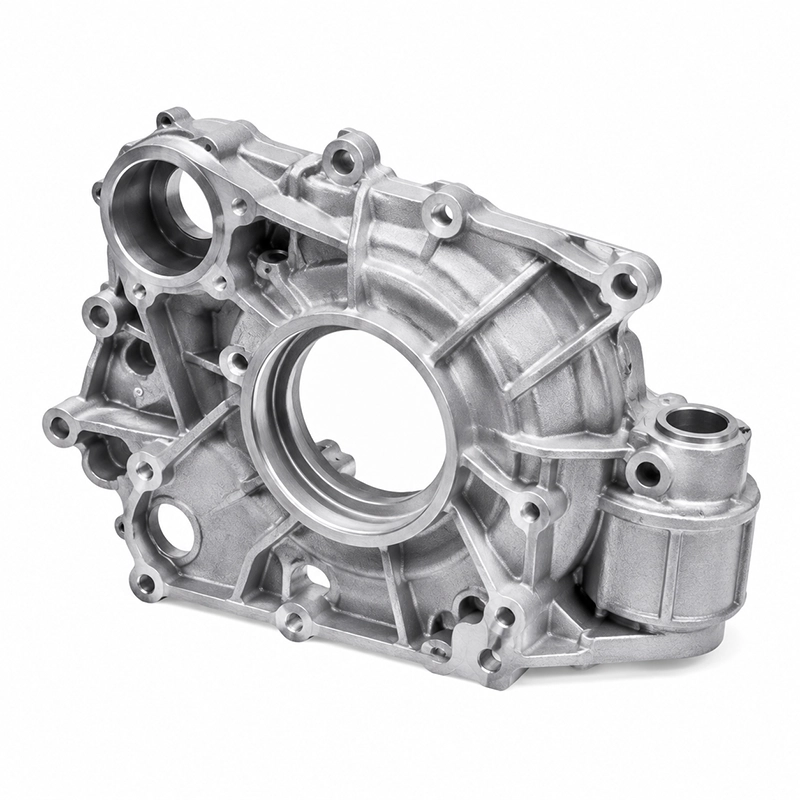

Die Cast Automotive Components
Quick Info:
- Material: Aluminum Alloy / Zinc Alloy
- Process: High Pressure Die Casting
- Wall Thickness: 1.5–5.0 mm
- Dimensional Tolerance: ±0.10–0.30 mm
- Surface Finish: Shot Blasting / Machining / Coating
- Lead Time: 15–30 Working Days

Get Free Quote


Detailed Description
Die cast automotive components are designed for vehicle systems requiring lightweight construction, dimensional consistency and efficient mass production. Typical products include brackets, structural supports, motor covers, transmission components, sensor housings and electronic mounting parts.
Aluminum alloys are widely used due to their excellent strength-to-weight ratio, corrosion resistance and thermal performance. Zinc alloys can be selected for smaller precision components requiring complex geometries and tighter dimensional control.
High-pressure die casting enables complex shapes with integrated ribs, bosses, mounting points and thin-wall structures. Secondary machining operations can be applied to critical surfaces, threaded holes and precision interfaces to meet assembly requirements.
Available Surface Finishes
- Shot Blasting: Removes casting marks and creates a uniform surface appearance.
- Machining: Provides precision surfaces, holes and threaded features.
- Powder Coating: Improves corrosion resistance and appearance.
- Anodizing: Available for selected aluminum components.
- Electroplating: Suitable for zinc alloy parts requiring enhanced surface protection.
Structural & Functional Breakdown
- Lightweight Structural Design: Reduces vehicle component weight while maintaining strength.
- Integrated Mounting Features: Bosses, ribs and brackets can be cast directly.
- Precision Assembly Interfaces: Machined surfaces improve component fit.
- Thin Wall Structures: Reduce material usage and overall weight.
- Heat Dissipation Features: Aluminum alloys support thermal management requirements.
Key Features
- Lightweight Metal Construction: Aluminum alloys provide strength with reduced weight.
- Complex Geometries: Multiple ribs, bosses and mounting structures can be integrated into one casting.
- High Production Efficiency: Die casting supports repeatable automotive production volumes.
- Secondary Machining Capability: Critical surfaces can be finished after casting.
- Material Flexibility: Aluminum and zinc alloys support different automotive requirements.
- Prototype to Production Support: Suitable for development samples and long-term manufacturing.
Applications
- Automotive Brackets
- EV Components
- Motor Mounts
- Sensor Housings
- Transmission Components
- Battery System Components
- Vehicle Structural Parts
- Automotive Electronics