




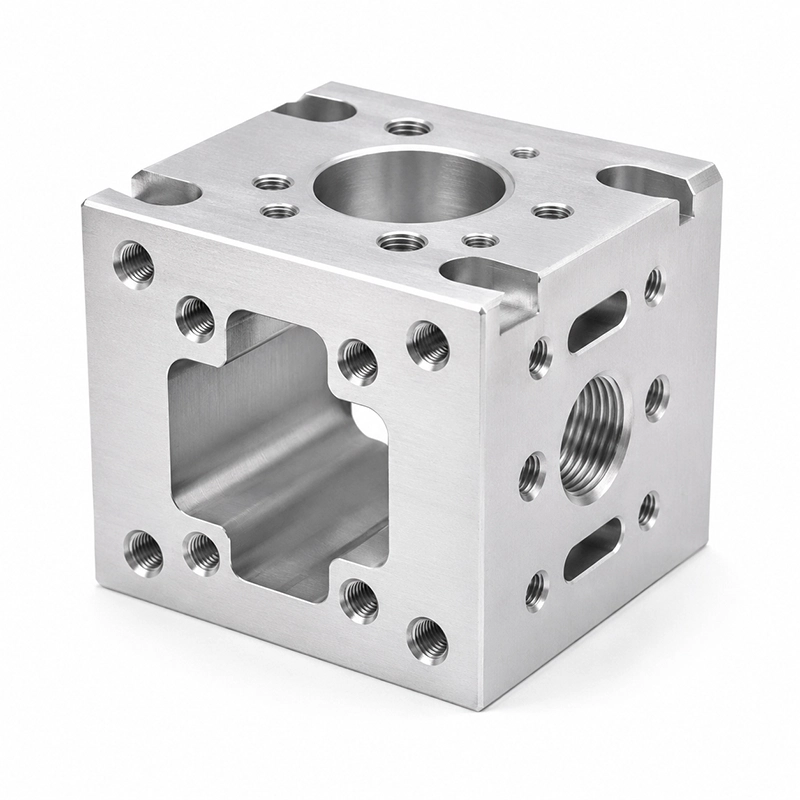

Precision CNC Milled Mounting Blocks
Custom CNC milled mounting blocks can be shaped around the equipment connection, with machined faces and holes arranged for the intended assembly. Depending on the part geometry, milled steps or pockets can create distinct seating areas for attached hardware. These components suit machinery and fixture applications where a small, locally positioned support is more appropriate than a broad mounting surface.
Quick Info:
- Process: CNC Milling
- Tolerance: ±0.02–0.05 mm
- Lead Time: 5–10 Working Days
- Material: Aluminum / Stainless Steel / Steel / Brass
- Surface Finish: Anodizing / Plating / Passivation
- MOQ: 1 Piece

Get Free Quote


Detailed Description
Compact equipment layouts often leave room for a small support block but not a full mounting plate. CNC milled mounting blocks place a locating bore, a tapped connection and a reference shoulder within one piece of material. Sensors, shafts or guides can sit against specific machined regions without an extra stack of shims and adapters.
Stepped faces lift one component above its neighboring surface. Slots create a limited adjustment path, while threaded holes attach the block to the machine base. Aluminum, carbon steel, stainless steel, brass and engineering plastics appear among the material options for these compact supports.
Small Locating Seats For Sensors And Guides
Several locating functions share a small machined body without spreading across a full mounting plate. Cylindrical bores hold a pin or bearing support, while a nearby shoulder stops another component at a defined height. Machined reference faces keep the connection clear even inside crowded mechanisms.
Available Surface Finishes
- As-Machined: Suitable for internal precision components.
- Clear Anodizing: Provides corrosion protection for aluminum parts.
- Black Anodizing: Common for automation and optical equipment.
- Hard Anodizing: Improves surface wear resistance.
- Nickel Plating: Available for selected metal mounting components.
- Passivation: Available for stainless steel versions.
Natural machined surfaces, anodizing and plating provide different visible finishes without changing the compact arrangement of bores and steps.
Structural & Functional Breakdown
- Precision Locating Bore: Supports shafts, pins, bearings or cylindrical components.
- Threaded Mounting Holes: Allow direct mechanical fastening.
- Reference Shoulders: Provide repeatable assembly positioning.
- Machined Slots: Enable adjustment during equipment installation.
- Stepped Geometry: Supports components mounted at different heights or positions.
Stepped seats separate nearby levels, while threaded holes hold the block in position. Locating bores offer their own points of contact within the same body.
Key Features
- Tight Positional Control: Suitable for components requiring accurate hole-to-hole relationships.
- Multiple Material Options: Aluminum, steel, stainless steel and brass available.
- Thread & Bore Machining: Supports tapped, reamed and precision-bored features.
- Compact Complex Geometry: Multiple mounting functions can be integrated into one block.
- Repeatable Production: CNC programs support stable batch-to-batch dimensions.
- Drawing-based Manufacturing: Custom dimensions produced from CAD files or technical drawings.
Several small machining details make the block useful as a discrete mechanical interface instead of a simple spacer.
Applications
- Sensor Mounting
- Linear Motion Systems
- Robotics
- Automation Equipment
- Bearing Supports
- Motor Mounting
- Optical Equipment
- Precision Machinery
Linear-motion equipment uses a mounting block to position a shaft support next to a guide rail. Raised shoulders and locating bores keep the surrounding components arranged in a small footprint.
Sensor mounts use CNC milled mounting blocks to attach a cylindrical device to a machine frame. Slotted fastening points allow limited adjustment while the machined seat holds the sensor body in place.

Frequently Asked Questions
-
What does a locating bore support?

-
Machined bores can seat a pin, small shaft, bearing or cylindrical sensor component inside the block.
-
Can a mounting block include stepped levels?
-
Yes. Stepped machined faces provide separate seating heights for neighboring components.
-
What is the function of a machined slot?
-
Slots create a controlled adjustment route for a fastening point during equipment installation.
-
Which materials are listed for these mounting blocks?
-
Aluminum, carbon steel, stainless steel, brass and engineering plastics appear among the available options.
-
How do threaded holes connect the block?
-
Tapped holes provide direct fastening points between the compact block and adjacent machine structures.
-
Are mounting blocks used with sensors?
-
Sensor mounting is among the listed applications, alongside linear-motion equipment and bearing supports.
-
Which finishes are available?
-
As-machined, clear or black anodized, hard anodized, nickel-plated and passivated finishes are included.
-
How are mounting blocks different from fixture plates?
-
Blocks concentrate a few locating and attachment features in a small form, while fixture plates distribute workholding features across a broader surface.


