




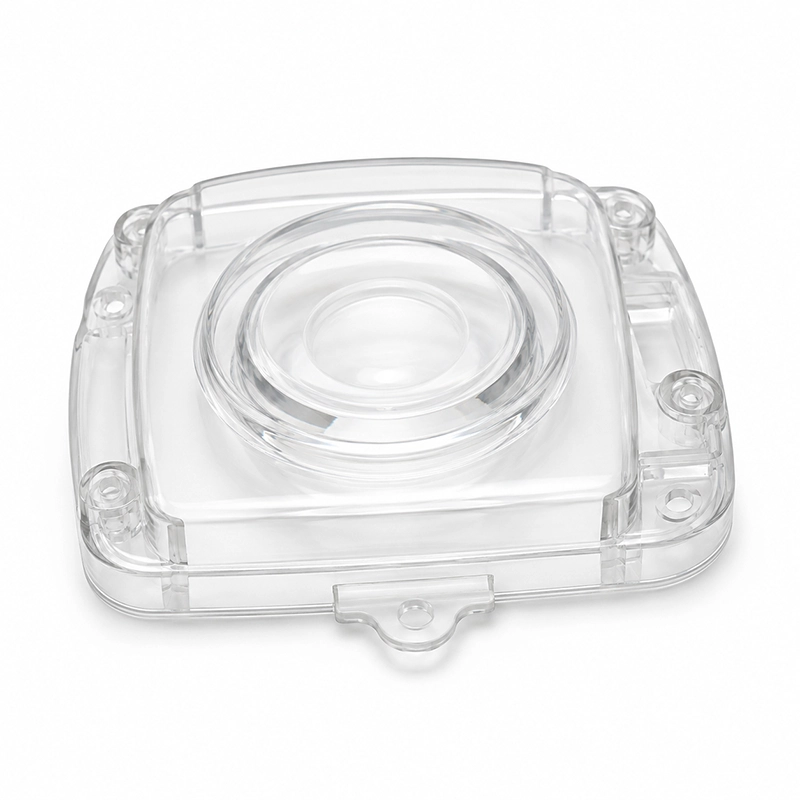

Vacuum Cast Transparent Plastic Parts
Transparent polyurethane vacuum casting can produce inspection windows, covers, light-guiding forms, and visual prototype components without dedicated injection tooling. Curves, openings, and attachment areas can be incorporated into the cast geometry. These clear vacuum cast parts are particularly relevant to limited production runs and design trials where the appearance, visibility, and assembly fit of a transparent element need to be reviewed together.
Quick Info:
- Wall Thickness: 1.5–6.0 mm
- Dimensional Tolerance: ±0.2–0.3 mm
- Material: Clear PC-like PU, Acrylic-like PU, Transparent Polyurethane
- Surface Finish: Gloss, Optical-style Polish, Frosted
- Lead Time: 5–12 working days

Get Free Quote


Detailed Description
When a colored indicator sits behind a curved cover, the finish of the transparent surface matters as much as the overall shape. Clear vacuum cast parts can represent inspection windows, illuminated labels and light-guide features in small quantities. A highly polished master establishes the initial surface condition that the silicone mold will reproduce.
The clear polyurethane passes through a vacuum casting stage that helps limit trapped air during filling. Resin selection and curing conditions influence the final visual result, while the master and mold determine how clearly the geometry transfers. An apparently clear sample may still show optical distortion, haze or color cast under certain lighting conditions.
Available Surface Finishes
- High-gloss Clear Finish: Supports a smooth clear surface for prototype applications.
- Polishing: Improves clarity on critical viewing surfaces.
- Frosted Finish: Creates diffuse light transmission.
- Transparent Tinting: Supports smoke, amber, blue or customized translucent colors.
Some projects need one transparent face and one diffuse face. Polishing can improve a selected viewing region; a frosted finish can spread light from an indicator. Smoke, blue or amber tinting may help assess the appearance of illuminated equipment, subject to compatible resin and pigment.
Structural & Functional Breakdown
- Transparent Window Structure: Allows internal components or indicators to remain visible.
- Lens-type Curved Surface: Supports decorative and basic optical prototype geometry.
- Integrated Mounting Feature: Tabs, bosses and holes can be reproduced in the same casting.
- Light-transmitting Surface: Suitable for evaluating illumination and visual effects.
Attachment tabs and mounting bosses can appear outside the main viewing zone. Positioning them there makes room for fasteners while reducing visible obstruction across the window. Curved lens-like surfaces can also be reproduced for shape review without implying qualified lens optics.
Key Features
- Clear Prototype Production: Avoids expensive transparent injection molding tooling.
- Fine Surface Replication: Silicone molds reproduce polished master geometry.
- Custom Transparent Colors: Resin can be tinted for different design evaluations.
- Low-volume Flexibility: Suitable for several prototype copies or design variants.
Clear vacuum cast parts support side-by-side evaluation of window geometry and surface treatments before a hard tool is released. For demanding optical use, measure light transmission, haze and dimensional properties using agreed methods instead of accepting a prototype solely by visual inspection.
Applications
- Transparent Covers
- Light Guides
- Indicator Windows
- Lighting Prototypes
- Display & Instrument Components

Frequently Asked Questions
-
How much does the master surface affect clarity?

-
The mold copies the master surface. Scratches or rough texture on the master can transfer to the casting and change its appearance.
-
Can transparent casting reduce visible air bubbles?
-
Vacuum casting can reduce trapped air, but final clarity also depends on resin handling, mold geometry and curing conditions.
-
Can one part combine clear and frosted areas?
-
Selected surfaces can receive different finishing treatments, provided the geometry and access allow the required finish.
-
Are smoke or colored transparent variants possible?
-
Tinted clear resin options allow illuminated windows and display covers to be viewed in several colors, with the formulation influencing shade and light transmission.
-
Can a vacuum-cast part function as a precision lens?
-
Curved lens-like forms can reproduce the visual shape of a light guide or cover. Optical properties depend on the selected resin, surface condition and geometry.
-
Can mounting tabs be cast alongside the window?
-
Yes. Suitable tabs, bosses and openings can be reproduced from the master if they can release from the silicone tool.
-
Which visual defects should be inspected?
-
Inspect visible bubbles, haze, surface marks, color consistency and any distortion across critical viewing regions.
-
What information helps assess a light guide or inspection window?
-
Supply CAD geometry, viewing-zone boundaries, tint or finish requirements, lighting conditions and any needed optical measurements.


