




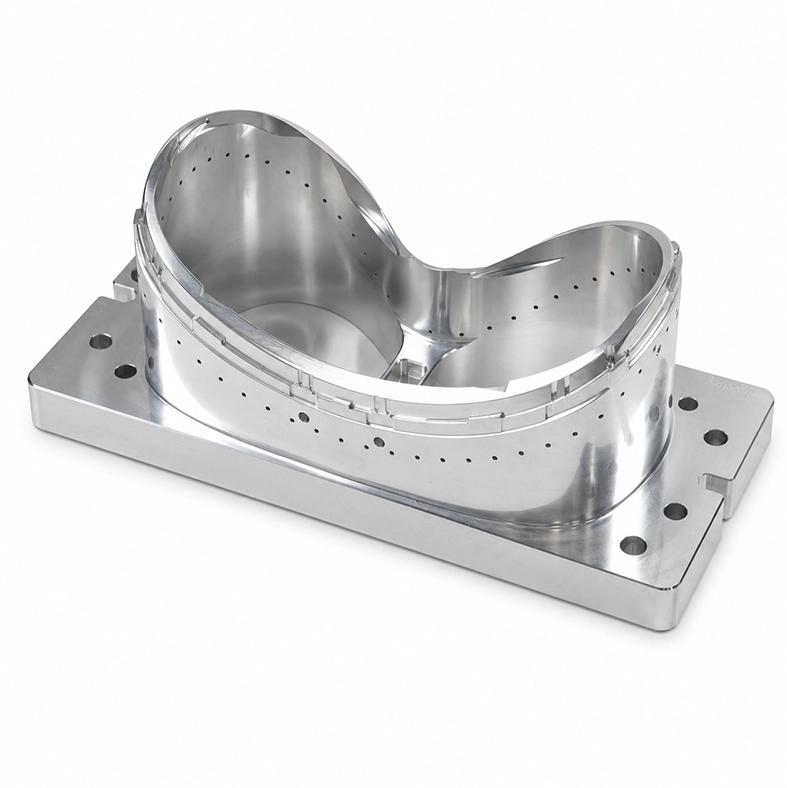

5-Axis CNC Complex Housings
Five-axis CNC machined housings can include internal cavities, threaded openings, bosses, and precision bores without limiting every feature to the same machining plane. This approach supports compact bodies used in pumps, robotics, instruments, and automation equipment.
Quick Info:
- Material: Aluminum 6061/7075, Stainless Steel, Magnesium, Engineering Plastics
- Technology: 5-Axis CNC Milling/ Boring/ Drilling/ Tapping
- Tolerance: ±0.01 mm
- Surface Finish: Ra 0.8–3.2 μm
- Lead Time: 7–15 working days

Get Free Quote


Detailed Description
Angled fluid ports and intersecting bores make 5 axis machined housings practical for equipment with crowded internal assemblies. Pump bodies, robotic actuator shells and hydraulic control blocks can place connection faces on different sides of one metal component. Five-axis machining reaches those surfaces with fewer changes in workholding orientation.
Bearing seats, pockets and attachment pads occupy separate functional zones of the same part. Flat mating faces establish contact with neighboring modules, while recessed channels make room for shafts, valves or wiring. Threaded holes sit near their intended installation points instead of requiring separate adapter brackets.
Multi-Face Bore And Port Relationship
Pump control housings may place the shaft passage along the main axis while angled ports emerge from a lateral face. Recessed mounting lands provide room for attached fittings without covering the bearing seat.
Available Surface Finishes
- Anodizing: Common protective finish for aluminum housings.
- Hard Anodizing: Suitable for components requiring improved wear resistance.
- Passivation: Used for stainless steel housings in corrosive environments.
- Powder Coating: Provides durable protective and decorative coverage.
Surface treatments cover exposed areas while machined seats and contact faces retain their specified geometry. Aluminum and stainless steel offer different finishing routes within the same family of housing designs.
Structural & Functional Breakdown
- Multi-port Housing Structure: Includes connection ports positioned on different orientations.
- Precision Bore Structure: Supports bearings, shafts, valves or fitted components.
- Integrated Mounting Boss Structure: Provides threaded installation points without separate hardware.
- Internal Pocket Structure: Reduces weight while providing internal clearance for functional components.
Multi-directional ports shorten external connection paths in densely assembled equipment. Internal pockets provide clearance without splitting the housing into several fastened sections.
Key Features
- Multi-face Machining in One Setup: Reduces repeated workpiece positioning.
- Precision Bore Alignment: Helps control relationships between multiple cylindrical features.
- Complex Internal and External Geometry: Supports pockets, bosses, ports and mounting interfaces.
- Integrated Thread Machining: Internal and external threaded features can be incorporated as required.
Tapped interfaces, reamed seats and localized deburring complete the mechanical details that meet the adjoining components.
Applications
- Pump Housings
- Robotics Components
- Automation Equipment
- Instrument Housings
- Mechanical & Hydraulic Systems
Pump assemblies can pair a central shaft bore with lateral fluid passages, bringing rotating and stationary parts together within a compact envelope. Robotics housings use the same multi-face approach to position actuator interfaces away from external mounting surfaces.
Continuous metal around the critical connection areas gives these housings a clear mechanical layout. Separate functional zones remain accessible from the appropriate installation directions, even when the surrounding equipment occupies several sides. Where angled passages meet compact drive layouts, 5 axis machined housings keep the mounting and internal clearance features in one continuous metal component.

Frequently Asked Questions
-
What types of ports can be incorporated into a machined housing?

-
Angled side connections, threaded openings and intersecting passages can coexist with flat mounting faces and precision bores.
-
How does five-axis machining help with intersecting bores?
-
Tool access from multiple orientations keeps related cylindrical features within a coordinated machining arrangement.
-
Can one housing support both bearings and external connectors?
-
Yes. Bearing seats and connector ports occupy separate zones, with internal pockets providing clearance between them.
-
Why are some housing surfaces reamed or tapped?
-
Reaming refines selected bore interfaces, while tapping forms threads for fasteners and fitted components.
-
What role do internal pockets serve?
-
Pockets create room for shafts, valve elements, wiring or adjacent mechanical pieces without increasing the outer envelope.
-
Are mounting bosses machined into the main body?
-
Integral bosses provide local material for threaded connections and contact surfaces within a one-piece metal housing.
-
Which finishes appear on aluminum and stainless steel housings?
-
Anodizing and hard anodizing serve aluminum; passivation serves stainless steel. Powder coating provides another exterior finish.
-
Where are multi-port machined housings commonly used?
-
Pump equipment, robotic assemblies, automation units, instruments and hydraulic mechanisms incorporate housings with several connection directions.


