
Black Oxide: A Versatile Surface Treatment

Black Oxide: A Versatile Surface Treatment
Black Oxide: A Versatile Surface Treatment

Black Oxide Effect
Black Oxide Effect

Introduction

Surface treatment plays a crucial role in enhancing the properties and appearance of various materials. One such method is black oxide, which has gained popularity in numerous industries.

This article will explore the definition, working principle, technical knowledge, advantages, and industry applications of black oxide, with references to TOP Prototype company.


Definition of Black Oxide

Black oxide is a chemical conversion coating process that forms a thin, black oxide layer on the surface of ferrous metals, such as steel and iron.

This layer provides a number of benefits, including improved corrosion resistance, enhanced appearance, and increased surface hardness.


Working Principle

 The black oxide process typically involves immersing the metal part in a heated alkaline solution containing oxidizing agents.

The chemical reaction between the metal and the solution leads to the formation of a magnetite (Fe₃O₄) layer on the surface. This layer is what
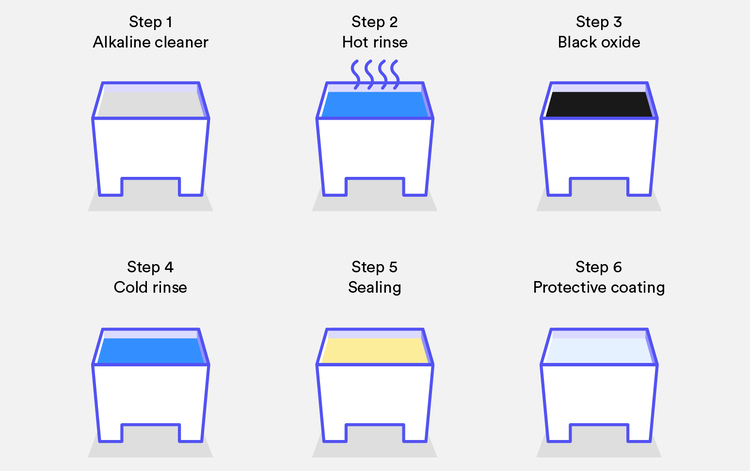
Black Oxide Working Principle

gives the characteristic black color. The process can be controlled to achieve different thicknesses of the oxide layer, depending on the specific requirements of the application. TOP Prototype company has mastered the precise control of this process to ensure consistent quality in their black oxide treatments.


Technical Knowledge
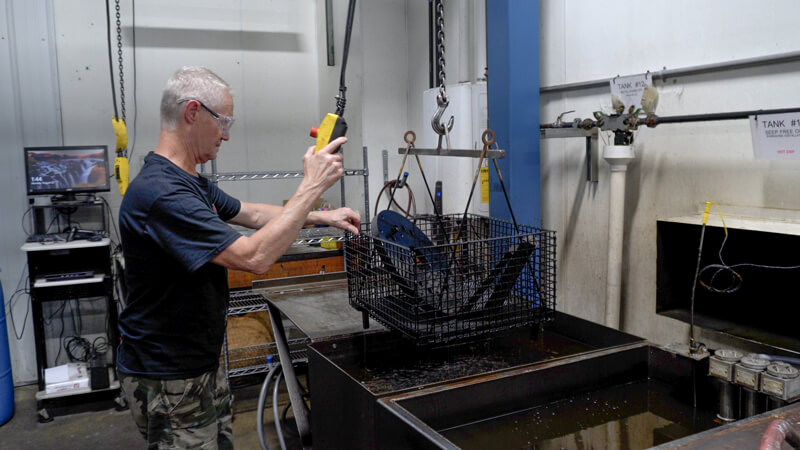
Worker is doing black oxidation

Solution Composition: The composition of the alkaline solution is carefully formulated to achieve the desired reaction.

It usually contains sodium hydroxide (NaOH), nitrates (NO₃⁻), and other additives. The concentration of these components can affect the speed and quality of the oxidation process.

Temperature and Time: The temperature of the solution and the immersion time are critical factors. Higher temperatures can accelerate the reaction but may also lead to uneven coatings if not properly controlled.

A typical temperature range is between 135°C and 150°C, and the immersion time can vary from 15 minutes to an hour or more, depending on the part size and desired coating thickness.

TOP Prototype company has conducted extensive research and experimentation to optimize these parameters for different types of parts.

Post-Treatment: After the immersion, the parts may undergo a post-treatment process, such as rinsing and oiling.

Rinsing removes any residual chemicals from the surface, while oiling can further enhance corrosion resistance and provide a smooth finish.

TOP Prototype uses high-quality oils and a meticulous rinsing process to ensure the best results.

Advantages of Black Oxide
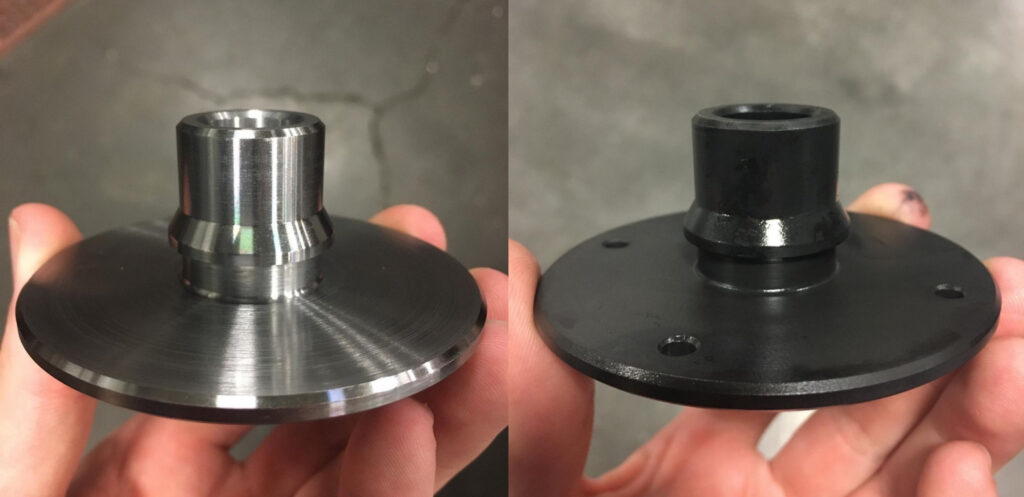
Before                                                                                After

Corrosion Resistance:

The black oxide layer acts as a barrier against moisture and other corrosive agents, significantly increasing the lifespan of the metal part.

Studies have shown that black oxide-treated parts can have a corrosion resistance improvement of up to 50% compared to untreated parts.

Aesthetic Appeal:

The black, matte finish provided by black oxide gives a professional and attractive appearance. It is often used in applications where a sleek, non-reflective surface is desired, such as in firearms, machinery parts, and decorative hardware.

Cost-Effective:

The black oxide process is relatively inexpensive compared to some other surface treatment methods. It requires less expensive equipment and chemicals, making it a viable option for both small and large-scale production.

TOP Prototype company is able to offer competitive pricing for their black oxide services while maintaining high quality.

Enhanced Lubricity:

The oxide layer can provide a certain degree of lubricity, which reduces friction between mating parts.

This is beneficial in applications where smooth movement is essential, such as in mechanical assemblies.

Compatibility with Other Processes:

Black oxide can be combined with other surface treatments, such as painting or plating, to further enhance the properties of the metal part. For example, a black oxide base layer can improve the adhesion of paint, resulting in a more durable finish.


Industry Applications


Automotive Industry

In the automotive sector, black oxide is used for treating various engine components, fasteners, and suspension parts. It helps to protect these parts from corrosion and wear, ensuring the reliability and performance of the vehicle.

TOP Prototype has supplied black oxide-treated parts to several leading automotive manufacturers, meeting their strict quality standards.

Aerospace Industry

The aerospace industry demands high-quality surface treatments to withstand the harsh operating conditions. Black oxide is used on aircraft engine parts, landing gear components, and structural fittings. Its corrosion resistance and lightweight nature make it an ideal choice for these applications.

TOP Prototype’s black oxide treatments have been approved for use in some aerospace projects, demonstrating their compliance with the industry’s stringent requirements.

Firearms Industry

Black oxide is a popular choice for finishing firearms due to its attractive appearance and corrosion resistance. It gives a classic, matte black look to guns while providing protection against rust and wear.

Many firearm manufacturers rely on TOP Prototype for their black oxide coating needs to ensure the quality and durability of their products.

Tool and Die Industry

Tools and dies need to be durable and resistant to wear and corrosion. Black oxide is applied to cutting tools, molds, and dies to increase their lifespan and performance.

TOP Prototype’s expertise in black oxide treatment has helped tool and die manufacturers improve the quality of their products, leading to reduced production costs and increased productivity.

Hardware and Plumbing Industry

In the hardware and plumbing sectors, black oxide is used for treating faucet parts, door hinges, and bolts. It provides a decorative finish while also protecting the metal from corrosion in wet and humid environments.

TOP Prototype has a significant presence in this market, supplying black oxide-treated hardware components to various customers.


Black oxide is a valuable surface treatment method with a wide range of applications in different industries.

Its working principle, technical knowledge, and advantages make it a preferred choice for enhancing the properties and appearance of ferrous metal parts.

TOP Prototype company has established itself as a leading provider of black oxide services, leveraging its expertise and innovation to meet the diverse needs of customers.

As industries continue to evolve and demand higher quality surface treatments, black oxide is likely to remain an important part of the manufacturing process, and TOP Prototype will continue to play a crucial role in its application and development.

With its combination of corrosion resistance, aesthetic appeal, and cost-effectiveness, black oxide is set to contribute to the performance and durability of products for years to come.

Let's Start A New Project Today

Latest Blog Posts

Check out the latest industry trends and take inspiration from our updated blogs, giving you a fresh insight to help boost your business.

Tapped Holes vs Threaded Holes – Differences and Comparison

Tapped Holes vs Threaded Holes – Differences and Comparison In mechanical manufacturing, assembly, and precision engineering, internal threaded holes serve as the “connective tissue” of components, enabling secure fastening, precise positioning, and stable load transmission. Tapped holes and threaded holes, two widely applied types of internal threaded structures, are often conflated due to their overlapping functional goals. Yet their divergence in processing principles, structural integrity, and practical performance is substantial—differences that directly affect product reliability, production costs, and service life. This article systematically distinguishes the two, enriches the discussion with industrial practices and material science facts, simplifies complex terminology, and reconstructs the logical framework to clarify their characteristics, advantages, and application boundaries for engineering practitioners. 1. Definitions and Core Structural Traits 1.1 Tapped Holes: Direct Thread Formation in Base Material A tapped hole is an internal threaded hole formed by the tapping process, where a specialized cutting tool (tap) cuts or forms threads on the inner wall of a pre-drilled pilot hole. Unlike indirect threading methods, tapped holes integrate threads directly into the workpiece’s base material—no auxiliary inserts or reinforcements are involved. Taps operate on a subtractive principle: they remove excess material from the pilot hole’s inner surface to form standardized thread profiles, such as metric (M series), unified coarse (UNC), or unified fine (UNF) threads, with precision grades ranging from 2B (general purpose) to 3B (high precision) for imperial threads. This integration with the base material means tapped holes’ performance is inherently tied to the workpiece’s material properties. For instance, in medium-carbon steel (e.g., 45# steel) or 6061 aluminum alloy—materials with moderate ductility and strength—tapped holes deliver reliable thread retention. They are widely adopted in scenarios where the workpiece itself can bear fastening loads, avoiding the need for additional components. 1.2 Threaded Holes: A Broad Category with Indirect Threading Dominance The term “threaded hole” is a generic concept encompassing all holes with internal threads, including tapped holes. In industrial practice, however, it primarily refers to holes where threads are formed indirectly—most commonly via threaded inserts. These inserts, made of high-strength materials like 304 stainless steel or titanium alloy, are installed into pre-drilled holes to provide the internal thread interface, decoupling thread performance from the workpiece’s base material. Beyond insert-based threading, threaded holes also include structures formed by thread rolling, casting, or injection molding. Thread rolling, for example, is used for high-volume production of ductile materials like copper or low-carbon steel, forming threads through plastic deformation rather than cutting. Cast or molded threaded holes are integral to composite parts (e.g., glass-fiber reinforced plastic) or plastic components, where threads are pre-designed in the mold to eliminate post-processing. 2. Core Differences in Processing Principles and Operations The fundamental gap between tapped holes and threaded holes lies in their thread formation mechanisms—each dictating processing efficiency, precision limits, and material applicability. Simplifying these mechanisms reveals why each is preferred in specific scenarios. 2.1 Tapped Holes: Two-Step Subtractive Processing Tapping follows a rigid two-step workflow: first, drilling a pilot hole with a diameter strictly matched to the target thread (e.g., a 6.8mm pilot hole for an M8×1.25 tap); second, cutting threads using a hand tap (for small batches or manual operations) or machine tap (for automated production on CNC lathes, milling machines, or dedicated tapping centers). Critical process parameters directly impact thread quality: tap speed (typically 10-30 m/min for steel, 20-50 m/min for aluminum), feed rate (matched to thread pitch to avoid thread distortion), and lubrication (cutting oil for ferrous metals, cutting fluid for non-ferrous metals to reduce friction and prevent burring). Brittle materials like gray cast iron (HT200) or zirconia ceramic require specialized spiral-flute taps to evacuate chips and avoid cracking, while ductile materials like copper demand straight-flute taps for smooth chip removal. 2.2 Threaded Holes: Indirect Formation with Diversified Methods Insert-based threaded holes, the most common type, follow a three-step process: drilling a hole matching the insert’s outer diameter (e.g., a 10.2mm hole for an M8 helical insert), installing the insert via pressing, self-tapping, or adhesive bonding, and verifying thread accuracy. Helical wire inserts (HeliCoils), for example, are coiled stainless steel wires with a diamond cross-section—when installed, they expand to lock into the pre-drilled hole, distributing fastening loads over a larger surface area to prevent thread stripping. Other threading methods for threaded holes have clear niche applications: thread rolling achieves higher thread strength (up to 30% higher than cut threads due to work hardening) and is used for high-volume parts like automotive bolts; casting/molding eliminates post-processing but is limited to parts with simple thread geometries, as complex threads may cause mold release issues. 3. Performance Comparison and Practical Application Scenarios Evaluating strength, precision, cost, and maintainability reveals the practical trade-offs between tapped holes and threaded holes. Grounded in industrial data and real-world cases, this comparison helps engineers make evidence-based selections. …

Analysis of Causes and Solutions of Surface Roughness Issues in CNC Machining

Analysis of Causes and Solutions of Surface Roughness Issues in CNC Machining In CNC machining, surface roughness is critical—it directly …

TOP Prototype CNC Customization Precision Machining Tailored Solutions for Global Industrial Innovation   The Art and Science of TOP Prototype CNC Customization   CNC customization blends engineering precision with creative …

Scroll to Top

Contact Us

Upload Your Files to Get Instant Quote and DFM Feedback
(Please attach 2D CAD drawings and 3D CAD models in any format including STEP,STP, IGES, DWG, PDF, STL, PDF, JPG , ZIP, RAR, etc